

Every food delivery article I have seen this year has the word "AI" on it somewhere. Drones, robot kitchens, a chatbot that picks your dinner, "AI-powered dispatch". Founders put it there because investors expect it, and investors expect it because every other deck has it.
I run technology at a food delivery company. I spend AI budget the way any CTO in an emerging market does: carefully, because every taka spent on a model is a taka not spent on riders, restaurants or reliability. So here is my scorecard. It covers where AI has a clear, measurable payoff in a delivery business, and where it is mostly hype for a company at our stage.
The three-question test
Before any AI project gets engineering time at our company, it has to pass three questions. Most hype fails at least one of them.
- Does it move a number we already track every week? Late orders, refunds per 100 orders, cost per support ticket, menu conversion. If the benefit can only be described as "better experience", it is not ready.
- Do we own the data that trains or grounds it? Order timestamps, rider GPS, refund history and menus are ours. Taste profiles, kitchen camera feeds and city-wide traffic models usually are not, at least not at useful quality.
- What does it cost when the model is wrong? A bad restaurant recommendation costs one scroll. A wrong refund decision costs money and a customer. A wrong dispatch decision delays several orders at once. The higher the cost of an error, the more you need a human or a rule as a backstop.
The projects that pass all three share a pattern. They sit on high-volume, repetitive decisions with clean historical data and a cheap fallback. That describes four areas well.
Pays off #1: ETA and prep-time prediction
The delivery time shown at checkout is the most important number in the app. It is a promise, and every broken promise turns into a support ticket, a refund request or a lost customer.
A delivery ETA is really three predictions stacked together:
- Prep time: how long this restaurant takes for this basket at this hour.
- Rider arrival: how long until a rider reaches the restaurant.
- Last mile: how long from pickup to the customer's door.
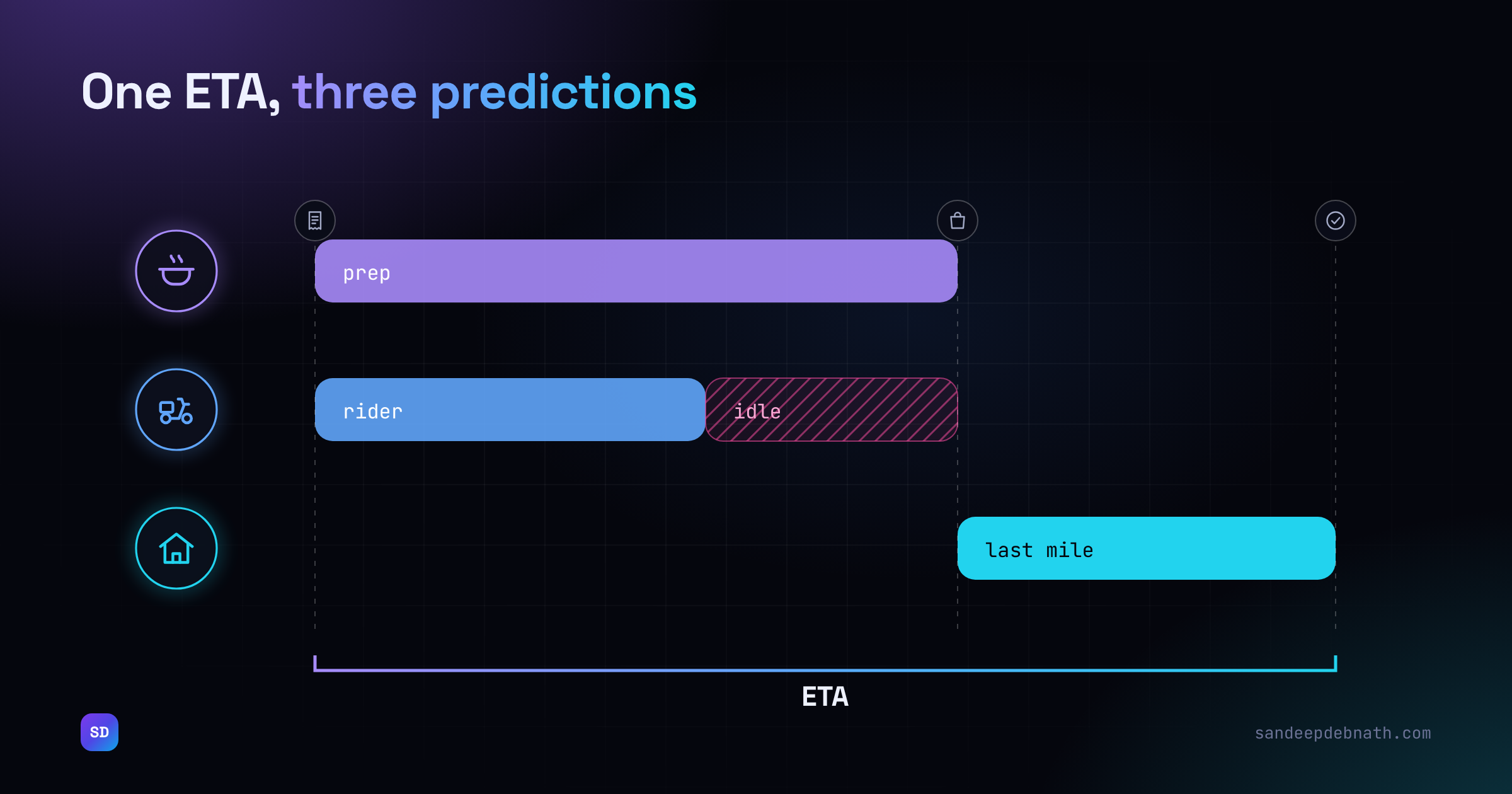
Prep time is where models earn their keep. Restaurants are terrible at reporting it, and a fixed "20 minutes" is wrong for a biryani house at 1:30 pm on a Friday. A gradient-boosted model trained on your own order timestamps (order placed, accepted, rider arrived, picked up) beats hand-set values within weeks. You do not need deep learning for this. You need clean event timestamps.
The payoff comes twice. Customers get honest promises, and dispatch stops sending riders to wait 15 minutes outside a kitchen. Rider idle time is cost you pay for whether or not the food is ready.
Where it goes wrong: treating ETA as a pure ML problem. If riders mark "picked up" late, or restaurants accept orders before they start cooking, the model learns that bad data very faithfully. Fix event capture first.
Pays off #2: fraud and abuse detection
Every delivery platform leaks money in small amounts that add up: "item missing" claims, promo codes shared across hundreds of fake accounts, riders and customers colluding, and cash-on-delivery orders that are never meant to be accepted.
This is a natural fit for machine learning. The volume is high, the patterns change faster than anyone can write rules, and the signals are all in your own data: device IDs, address clusters, refund history, payment method, order value and time of day.
The right design is a risk score, not an automatic verdict:
- Low risk: refund instantly. Honest customers, who are the large majority, get a great experience.
- Medium risk: ask for a photo, or offer a credit instead of cash.
- High risk: send to a human agent with the evidence already gathered.
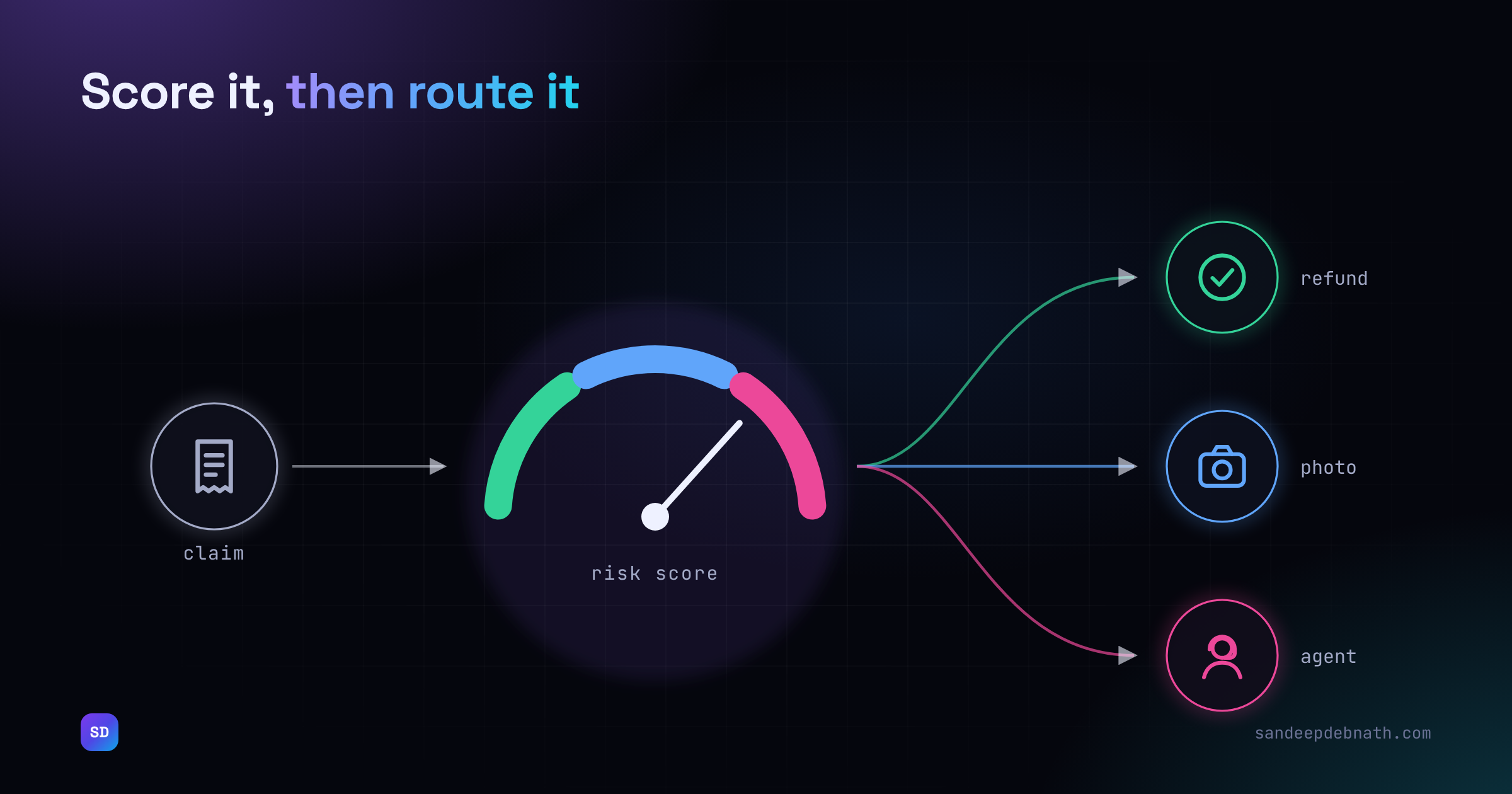
That last point matters. When platforms tighten refund rules too bluntly, genuine customers pay the price. Indian users have complained publicly that stricter refund controls add friction to legitimate complaints. A fraud model should make the honest path faster, not just the dishonest path harder.
In Bangladesh, cash on delivery adds its own fraud surface: fake orders, refused deliveries and cash shortfalls in rider settlement. Scoring an order's COD risk before you assign a rider is one of the highest-return models a South Asian platform can build.
Pays off #3: menu digitisation and catalogue quality
This is the most underrated AI use case in food delivery, and the one where large language models have changed the economics the most.
Onboarding a restaurant used to mean someone typing a printed menu into a CMS by hand. Item names were inconsistent, prices had typos, descriptions were missing and photos were blurry. Every one of those problems hurts search and conversion.
Today a vision-capable LLM can turn a photo of a menu card into structured items, prices, categories and variants in minutes. It can also:
- write short, accurate descriptions;
- tag cuisine, spice level and dietary attributes so search and filters actually work;
- spot duplicates and price anomalies across branches of the same brand.
Photos matter too. Swiggy launched an AI photo tool for restaurant menus in 2023 and said better images can drive "up to five times more orders". That is the company's own claim, but the direction matches what every operator sees.
The key is human review. The model drafts, a catalogue team approves, and the restaurant confirms prices. Done that way, onboarding gets faster and catalogue quality goes up together. A wrong price on a live menu is a real problem, so never skip the approval step.
Pays off #4: support automation, done right
Support is one of the biggest operating costs in a delivery company, and most tickets fall into a few types: where is my order, item missing, wrong item, refund status, cancel my order.
The scale of the opportunity is clear. Zomato built an in-house AI support platform, Nugget, which the company says handles over 15 million support interactions a month across Zomato, Blinkit and Hyperpure and can answer up to 80% of queries on its own.
The risk is just as clear. A March 2026 Storyboard18 report described customers stuck in scripted bot loops with "no clear option to reach a human agent". Automation that saves cost but loses customers is not a saving.
What works:
- Answer from live data, not scripts. "Your rider is 600 m away and will arrive in about 4 minutes" ends the conversation. "We are looking into it" starts a second one.
- Let the bot act, not just talk. It should be able to issue a low-risk refund or credit within limits set by the fraud score.
- Always offer a human exit. Escalate quickly on angry language, repeat contacts or high-value orders.
- Measure resolution, not deflection. A ticket the bot "handled" that comes back the next day was not resolved.
Where it's hype (for now)
These ideas are not stupid. They just fail the three-question test for most delivery companies today, especially in dense, price-sensitive South Asian cities.
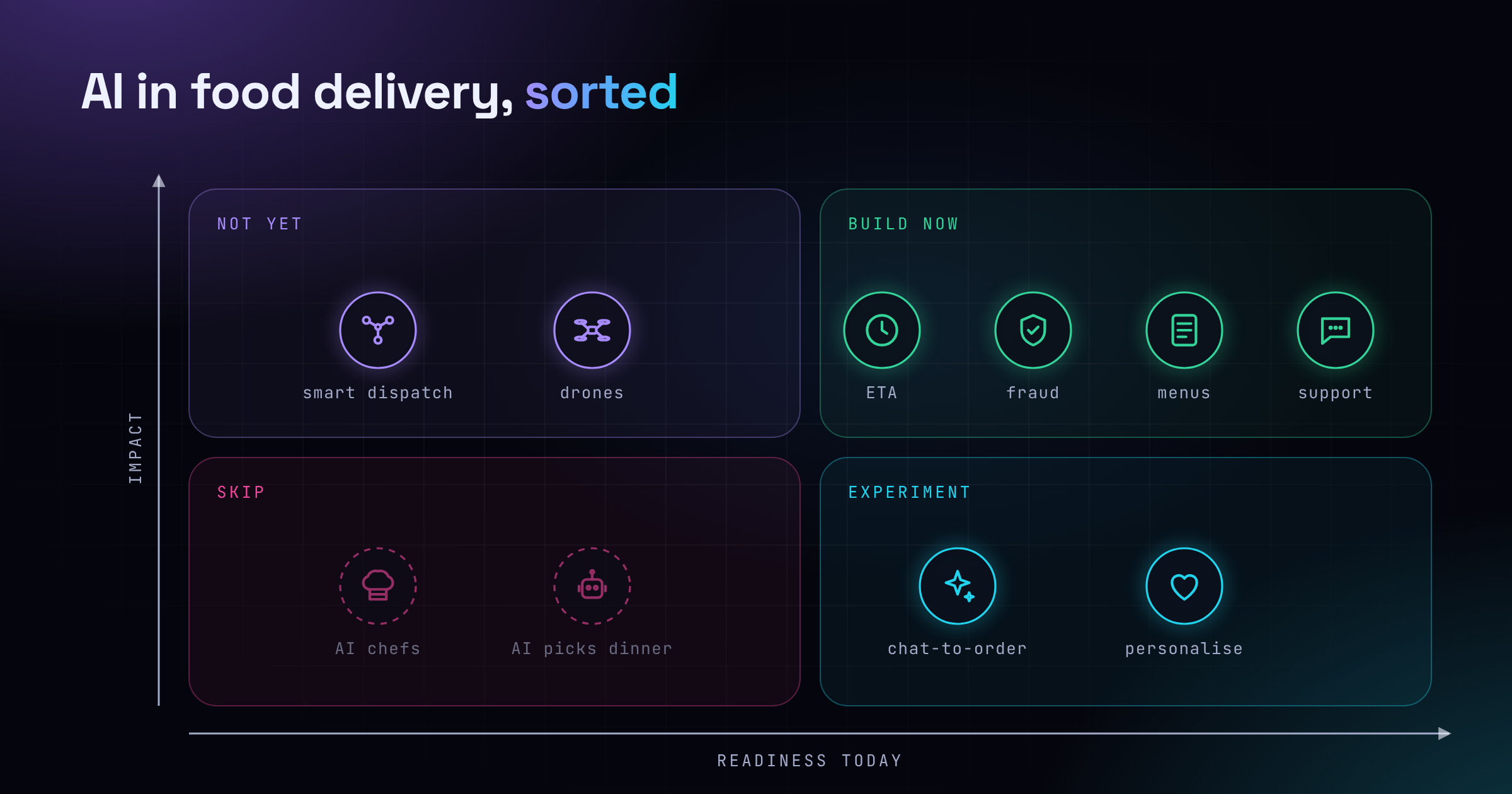
Drone and robot delivery. The demos look good. Regulation, airspace, monsoon weather, apartment blocks without landing spots and the low cost of a motorbike rider in Dhaka make the economics hard to justify. This is a research bet for very large players, not a roadmap item.
"The AI picks your dinner." Recommendation models help at the edges, such as reordering a favourite or showing what's popular nearby. But most people open a delivery app already knowing roughly what they want. A homepage that is 5% better personalised rarely beats one that is fast, accurate and has good restaurants.
Chat-to-order. Ordering through an AI assistant is real now. Swiggy opened ordering through ChatGPT, Claude and Gemini in January 2026 using the Model Context Protocol, but it has not published usage numbers. It is a sensible, cheap experiment for a platform of that size. It is not yet proof that customers prefer typing to tapping, and it should not be anyone's main growth plan.
"AI-first" dispatch on day one. Rider assignment is a hard optimisation problem, but fancy optimisation on top of bad ETAs and noisy GPS just produces confident mistakes. Start with good rules and good predictions, then optimise.
AI kitchens and demand-driven menus. Predicting demand to help restaurants prepare is useful. Claims that AI will design menus or run kitchens belong in the pitch deck, not in next quarter's plan.
South Asia realities
Most published AI playbooks come from the US, China or India's largest platforms. Running one in Bangladesh adds constraints those playbooks rarely mention.
- Data quality beats data volume. Addresses like "behind the mosque, third gate, blue building" break geocoding. GPS drifts between tall buildings in Gulshan and Motijheel. Before any model, invest in address normalisation and pin confirmation.
- Language is mixed. Customers write in Bangla, English and Banglish, often in one message. Test any support or search model on real local tickets, not on clean English benchmarks.
- Cost per order is the real limit. Average order values are a fraction of Western ones. An LLM call that is trivial for a $30 order can matter for a 300-taka order. Use small models, caching and rules wherever they work, and save large models for tasks that need them.
- Talent is scarce, so buy before you build. For OCR, translation and general LLM tasks, use hosted APIs. Spend your scarce ML engineers on what is specific to you: prep-time, ETA and fraud models trained on your own data.
How I would sequence it
If I were starting AI work at a delivery company tomorrow, this is the order I would follow:
- Fix event capture. Make every order state change accurate and timestamped: accepted, food ready, rider arrived, picked up, delivered. Every model below depends on it.
- Prep-time and ETA models. Honest promises reduce support load and rider idle time at the same time.
- Fraud and refund risk scoring. Start rule-based, then add a model once you have labelled cases.
- LLM-assisted catalogue. Use hosted models with human approval. Onboarding gets faster almost immediately.
- Support automation on live data. Build it after ETA and fraud scoring exist, so the bot has true answers to give and safe limits to act within.
- Then experiment. Personalisation, conversational ordering and smarter dispatch, each with a clear metric and a kill date.
For every project, write down the metric, the baseline and the date you will judge it before you write any code. An AI feature with no baseline cannot be proven to work, and it cannot be switched off either.
The takeaway
In food delivery, AI pays off where it makes a promise more accurate or a repetitive decision cheaper: when food will arrive, whether a refund is genuine, what is on a menu, and what to tell a waiting customer. None of these make good conference keynotes. All of them show up in unit economics within a quarter.
The hype is usually about replacing something that already works, such as a rider, a menu tap or a cook. The payoff is usually about making the existing system tell the truth faster. If you are a CTO deciding where your next AI rupee or taka goes, start with the truth.


