

On 21 October, Eternal, the parent company of Zomato, reported its Q2 FY27 results. Blinkit, its quick commerce arm, processed Rs 20,940 crore in orders that quarter. Zomato's food delivery business, the company's original core, processed Rs 11,445 crore.
When Zomato agreed to buy Blinkit (formerly Grofers) in 2022, many investors questioned the deal. Today it is the larger business by a wide margin, and it is growing almost four times faster.
Most coverage treats this as a story about stock prices and market share. As someone who runs technology for a food delivery platform, I read it differently. Food delivery and quick commerce look alike from the customer's phone: an app, a cart, a rider at your door. Underneath, they are two very different machines. The shift from one to the other is a shift in what engineering teams have to be good at.
The numbers, read correctly
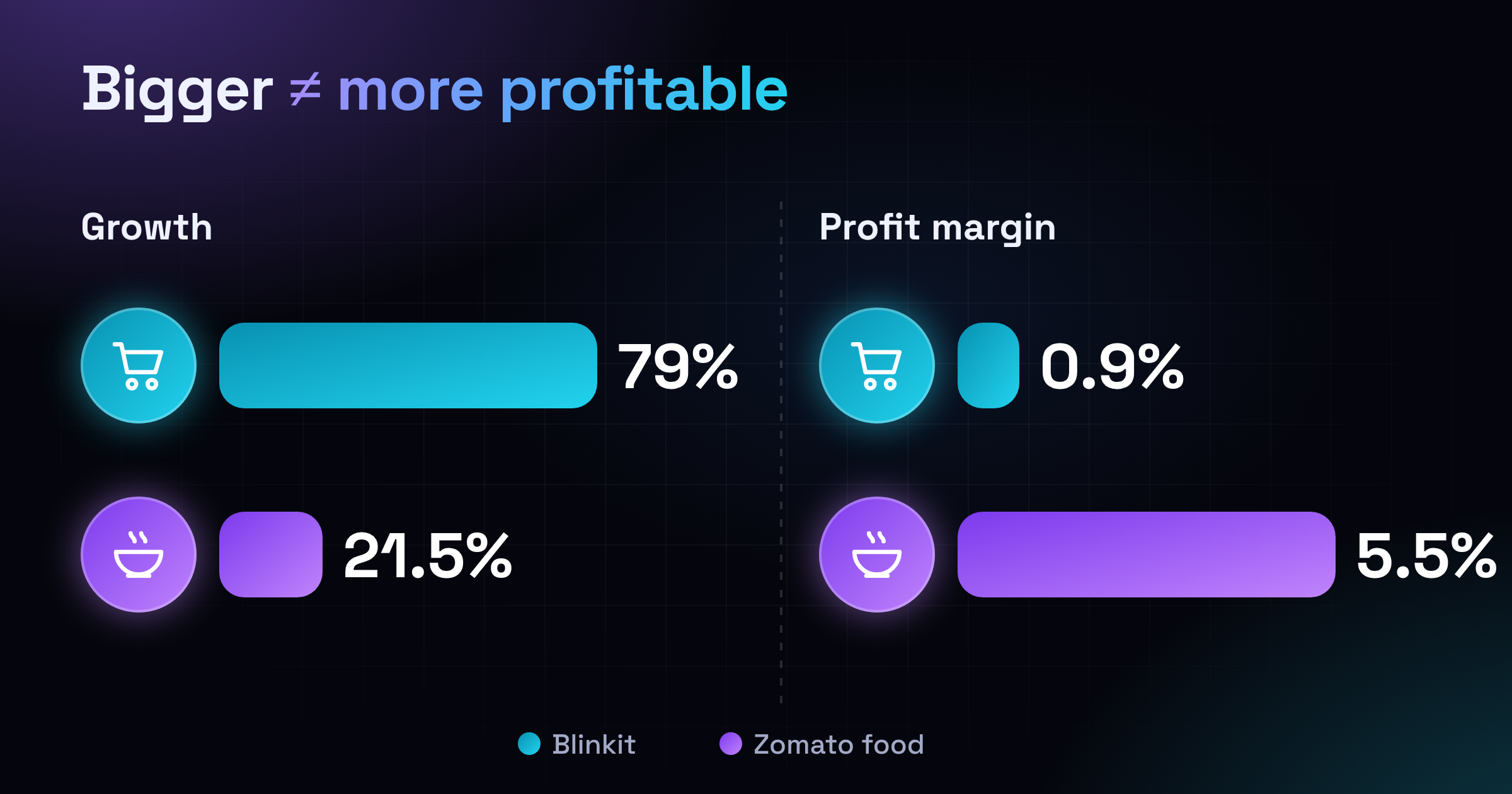
The headline comparison is net order value (NOV), the total value of orders placed. On that measure Blinkit is 1.8 times the size of food delivery.
Q2 FY27 (Jul–Sep 2026) | Blinkit | Zomato food delivery |
|---|---|---|
Net order value | Rs 20,940 cr | Rs 11,445 cr |
NOV growth, year on year | 79% | 21.5% |
Adjusted EBITDA | Rs 184 cr | Rs 627 cr |
Adjusted EBITDA as % of NOV | 0.9% | 5.5% |
Two caveats keep the analysis honest.
Ignore the revenue headline. Blinkit reported revenue of Rs 19,152 crore against Rs 3,396 crore for food delivery. That gap is mostly an accounting effect. In 2025 Blinkit moved to a first-party model, where it buys and sells inventory itself, so the full value of goods now counts as revenue. Food delivery still records only its commission and fees. Comparing the two revenue lines is comparing a shop's sales with a broker's fees.
Food still makes the money. Food delivery earned more than three times Blinkit's adjusted EBITDA on about half the order value. Blinkit only turned EBITDA-positive this year, a year after a Rs 156 crore loss. The size has shifted. The profit has not, yet.
Why quick commerce grows faster
Quick commerce grows faster because it sells to more occasions, more often. Three mechanics compound:
- Frequency. Most people order restaurant food a few times a month. Milk, bread, eggs, phone chargers and forgotten ingredients are needed every few days. Each customer simply has more reasons to open the app.
- Basket breadth. A food order is one restaurant's menu. A quick commerce cart can hold groceries, personal care, electronics and gifts at once. The catalogue keeps widening, and so does the basket.
- Advertising. Brands pay for visibility on the shelf, just as they do in a supermarket. Restaurants advertise too, but the pool of consumer-goods brands with marketing budgets is far deeper.
The same pattern shows up outside India. In its Q3 2026 results, Uber's delivery gross bookings grew 22% year on year, faster than its rides business at 18%. Delivery, including groceries and retail, is now almost as large as rides on Uber's platform. Everyday essentials are pulling ahead of occasional treats.
The technology gap: matching vs operating
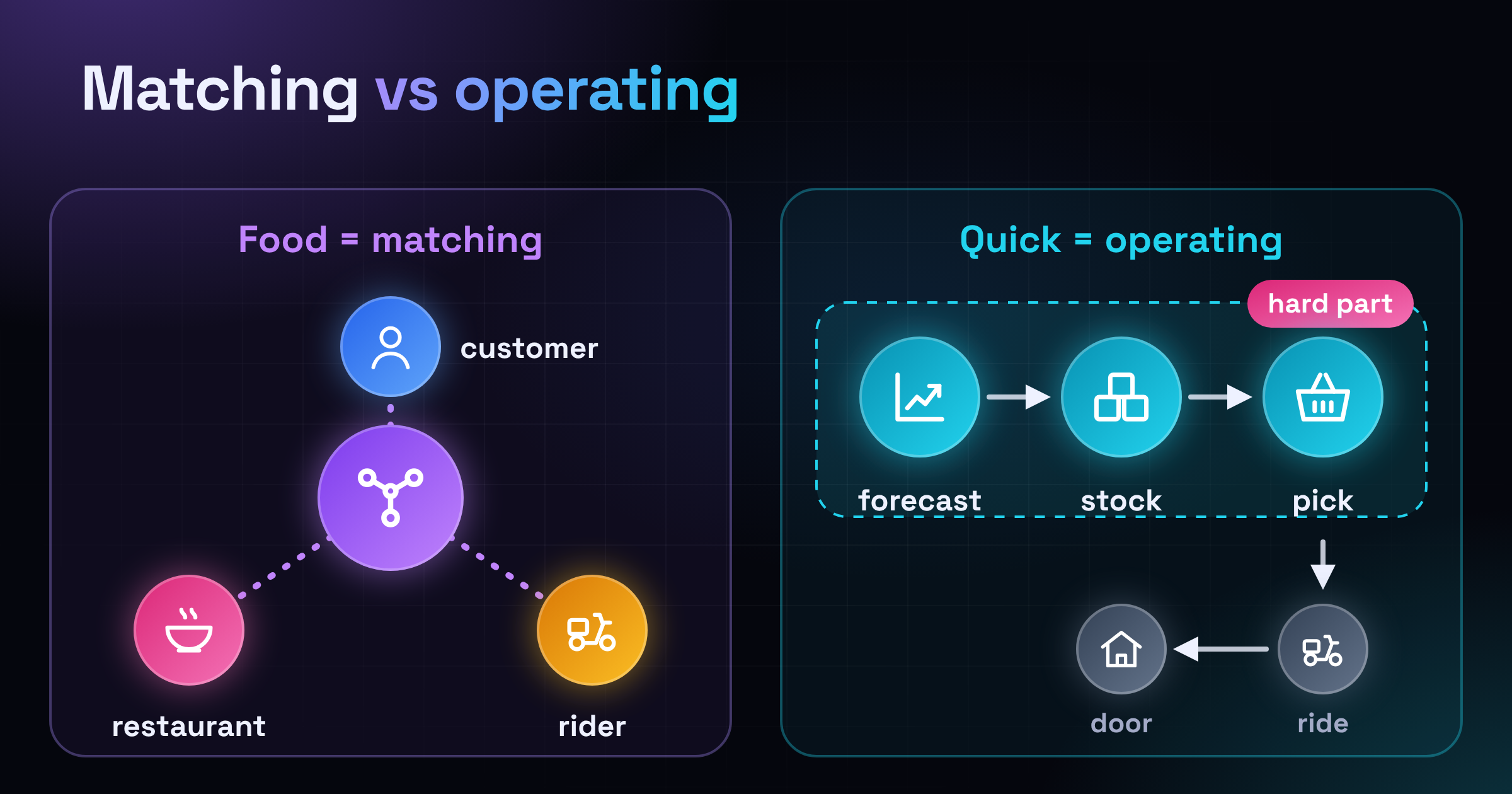
Food delivery is a matching problem. Quick commerce is a retail operations problem. That one difference changes almost every system you build.
In food delivery, the platform owns no inventory and no kitchen. Its core job is to connect three independent parties in real time: a customer, a restaurant and a rider. The hard engineering is in search and ranking, prep-time prediction, dispatch and ETAs. Restaurants carry the risk of running out of food.
In quick commerce, the platform runs the store. The 10-minute promise starts long before the customer orders:
- Demand forecasting per store, per product, per hour, so the right stock is on the shelf before anyone asks for it.
- Inventory and replenishment, tracking thousands of products across thousands of stores, with expiry dates and supplier lead times.
- Picking and packing inside the dark store, where shelf layout and picker routing decide whether an order leaves in 90 seconds or four minutes.
- Catalogue and pricing at supermarket scale, with real-time stock shown in the app so customers never order something that has run out.
Delivery is the easy part. With a dense network of dark stores, the last mile is short. The difficult work happens before the rider is called.
This is why a food delivery company cannot simply bolt on a grocery tab. The data model changes from orders to stock. The key metric changes from delivery time to availability. The team changes too: you need supply chain and forecasting skills, not only marketplace and logistics engineers.
The counterpoint: scale is not the same as a business
Blinkit's success is real, but it does not prove quick commerce works everywhere. The clearest evidence is its closest rival.
Swiggy's Instamart reported Rs 1,232 crore revenue in Q1 FY27 (Apr–Jun 2026), up 53%, with a segment loss of Rs 651 crore. It only reached contribution-margin break-even, where each order covers its own direct costs, in May 2026. That was across 1,171 dark stores in 131 cities. Nomura still expects Instamart to lose about Rs 3,100 crore in adjusted EBITDA this financial year, and Macquarie has flagged flat order growth (Inc42).
Even Blinkit, the leader, earns an adjusted EBITDA margin of 0.9% of order value. A dark store carries costs a restaurant marketplace never sees:
- rent for prime urban space, whether orders come or not;
- pickers and store staff on every shift;
- stock that expires, gets damaged or never sells;
- working capital tied up in inventory under the first-party model.
Each store only pays off once order density in its catchment area is high enough. Until then, every new store is a loss you have chosen to carry. Blinkit plans to reach more than 3,500 stores by March 2027, which is a bet that density will keep arriving.
What it means for Bangladesh and the region
Every food delivery founder in South and Southeast Asia is now being asked the same question: why aren't you doing quick commerce? For a market like Bangladesh, the right answer is "not the Blinkit way, not yet".
Dhaka has the density that makes 10-minute delivery possible. Few cities on earth have more people per square kilometre. But density is only one input. The others are harder:
- Basket size versus cost per order. In price-sensitive markets baskets tend to be small, while rent, staff and spoilage costs don't shrink in proportion. Run the store-level economics before you sign a lease.
- Supply chain maturity. Dark stores depend on reliable distributors, consistent product data and barcodes. Much of everyday retail here still runs through neighbourhood shops and informal wholesale.
- Customer habit. The corner shop is already five minutes away and often delivers. Quick commerce has to beat a habit, not just a supermarket.
So I would sequence it differently:
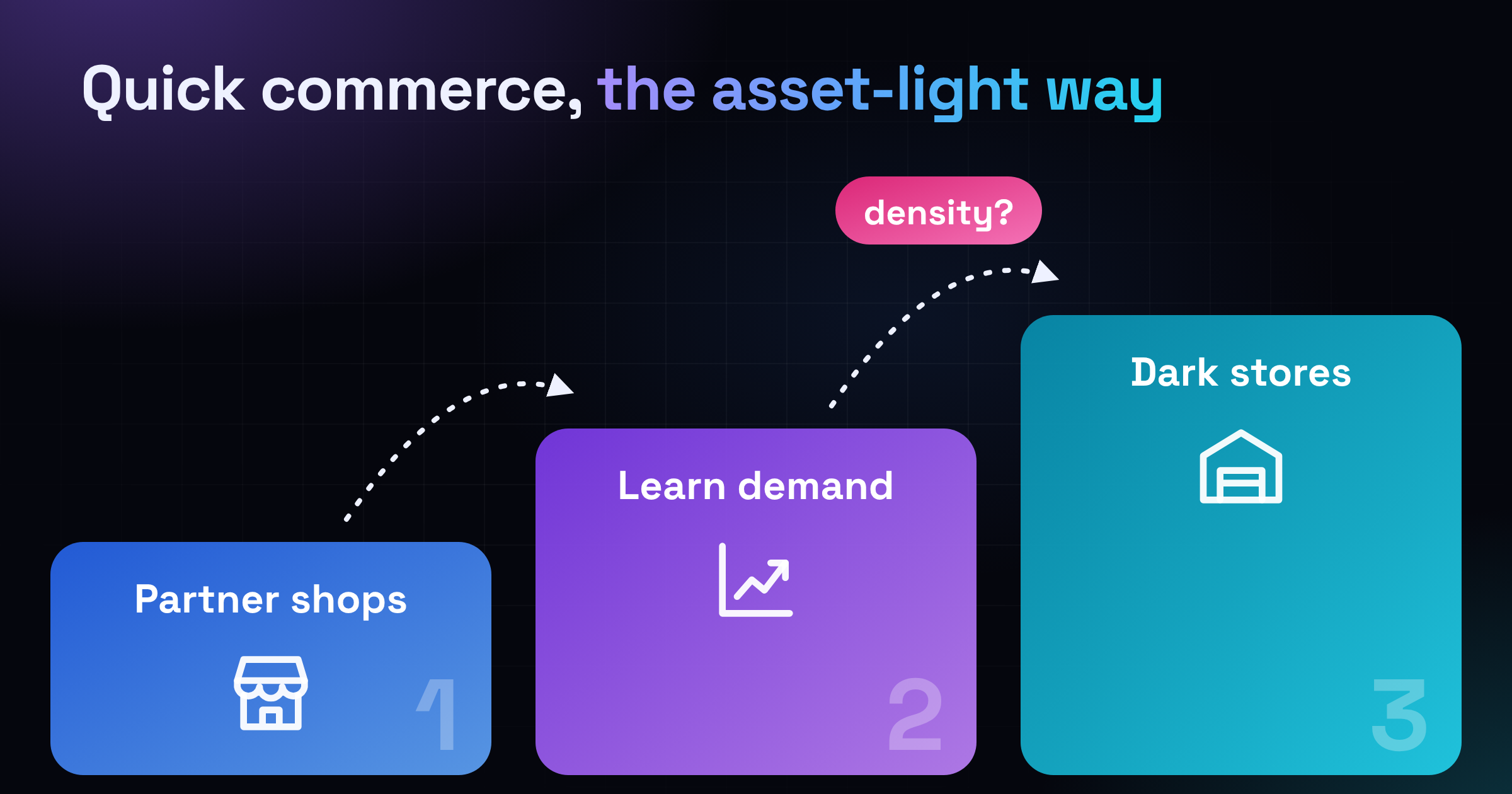
- Start asset-light. Partner with existing neighbourhood stores and supermarkets on a marketplace model, the same way food delivery works with restaurants. You reuse your dispatch and rider network and learn real demand without holding inventory.
- Build the data before the stores. Use those orders to learn which products sell where and when. That becomes your forecasting dataset.
- Open dark stores only where the data proves density. Start with one or two catchment areas where order volume already justifies the fixed cost, and measure each store's break-even honestly.
The lesson from Blinkit is not "build dark stores". It is that the platform with the most frequent customer relationship wins. In our markets, the fastest path to that relationship may run through the shops that are already there.
The takeaway
Blinkit overtaking Zomato's food business is not a sign that food delivery is dying. Food delivery still grew 21.5% and earned most of Eternal's operating profit. It is a sign that the centre of gravity in consumer delivery is moving from matching to operating: from connecting other people's supply to running supply yourself.
For CTOs, that is a skills question as much as a strategy question. The teams that win the next five years will understand both: real-time marketplaces and the slower, less glamorous science of stock, forecasting and stores. If your platform only knows one of them, start learning the other now, ideally before your board asks why you haven't.


