

One app. Three businesses. Only one of them really pays the bills. 🚗🍔🚚
Looking at Uber as a product portfolio rather than one company tells a clear story:
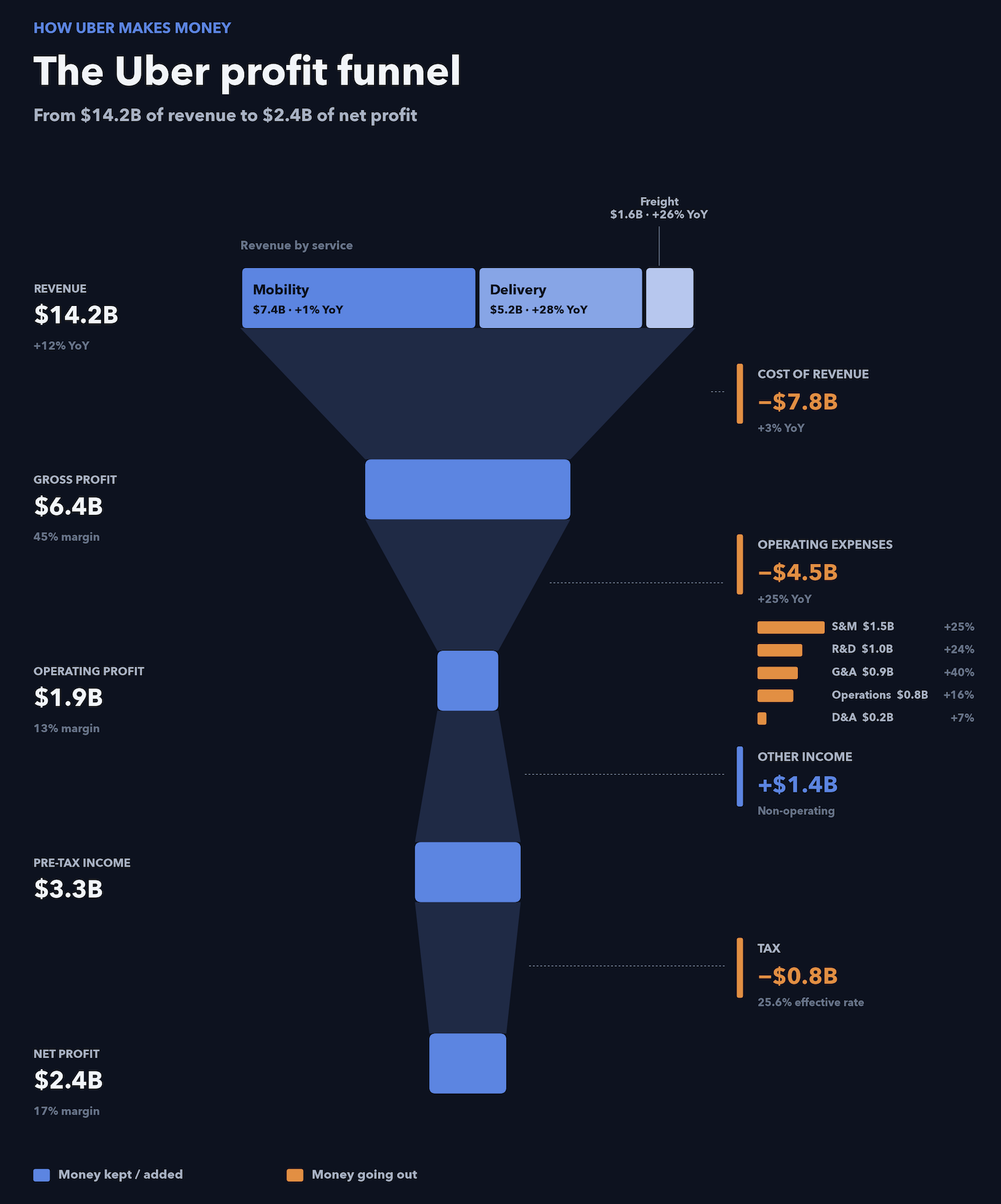
🔵 Mobility is the cash cow. Rides bring in 57% of revenue but 68% of the profit, at a ~27% margin, and it's still growing ~19% a year. This is what funds everything else.
🟠 Delivery is the growth engine. Uber Eats and grocery are growing fastest (+30%) and are now solidly profitable. Delivery also keeps users in the app between rides, which is where the super-app logic starts.
⚪ Freight is the break-even bet. 9% of revenue, roughly zero profit, flat growth. It isn't draining cash, but it isn't pulling its weight either.
The part I find most interesting as a product person: Uber doesn't launch the same product everywhere.
🇺🇸 US & Canada (~49% of revenue): the full stack. Rides, Eats, Uber One membership, ads and robotaxi pilots.
🌍 Europe, Middle East & Africa (~33%): rides lead in big cities, and Delivery is being scaled through deals like Trendyol Go in Turkey.
🌏 Asia Pacific (~11%): it depends on the country. Delivery is strong in Japan and Australia. In India and South Asia it's two- and three-wheelers (Moto, Auto) and no Eats.
🌎 Latin America (~7%): Mobility first, with Moto, cash payments and low-cost ride options.
Delivery is selective by market.
The lesson for anyone building platforms: find the one product the local market needs every day, make it your cash cow, then cross-sell. Launching everything, everywhere, all at once rarely works.
Which service would you lead with in your market? 👇
 #ProductManagement #ProductStrategy #Uber #PlatformThinking #SuperApp #GoToMarket #TechLeadership


